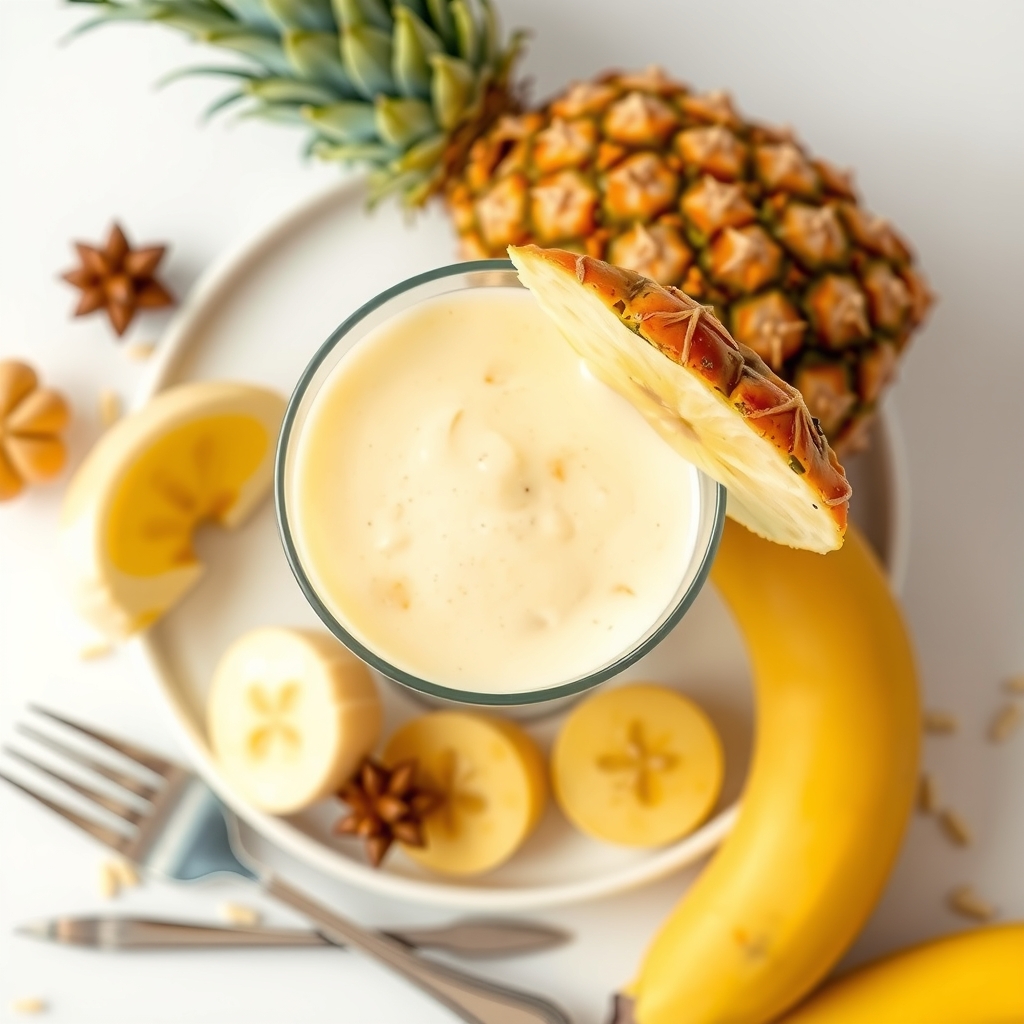
Pineapple and Banana Smoothie
Project Specifications
- Prep Time: 10 minutes
- Inactive Time: 0 minutes
- Cook Time: 0 minutes
- Total Time: 10 minutes
- Servings: 2
- Detailed Cost Estimate (USD):
- Pineapple: $2.00
- Banana: $0.50
- Greek Yogurt: $1.00
- Honey: $0.50
- Almond Milk: $1.50
- Total Cost: $5.50
The Ingredient Architecture
The Lipid Engine
- Greek Yogurt
- Almond Milk
The Starch Foundation
- Banana
The Aromatic Trinity
- Pineapple
- Honey
The Umami Matrix
- Greek Yogurt
The Phase-Based Workflow
Phase 1: Lipid-Starch Lamination
- Begin by peeling and slicing the banana into small pieces.
- Remove the skin of the pineapple and chop into manageable cubes.
- In a blender, combine the banana pieces and pineapple cubes.
- Add Greek yogurt and almond milk to the mixture.
- Drizzle honey over the top of the ingredients.
The Science
The interaction of lipids from Greek yogurt with the starch from the banana generates a rich mouthfeel, enhancing the overall textural experience. Emulsification occurs as the blender’s blades create a uniform consistency, dispersing lipids throughout the smoothie.
Phase 2: Homogenization
- Blend the mixture on high speed for approximately 1-2 minutes, or until a smooth and creamy consistency is achieved.
The Logic
During this phase, the vigorous blending causes the cellular structure of the fruits to break down, releasing sugars and flavors. The process of homogenization ensures that no single component overshadows another, leading to a balanced aroma and flavor profile.
Phase 3: Quality Control and Calibration
- Taste the smoothie and adjust sweetness if necessary by adding more honey.
- If the consistency is too thick, incrementally add more almond milk until the desired texture is achieved.
The Science
Calibration of sweetness involves the manipulation of sugar concentrations, and potentially, the perceived viscosity of the smoothie. The use of viscosity modifiers like almond milk ensures that the final product is palatable and easily drinkable, at a viscosity conducive to smooth consumption.
Resting and Servicing
Upon achieving the desired flavor and texture, pour the smoothie into chilled glasses. For optimal enjoyment, serve immediately, ensuring the temperature remains cool to enhance sensory experiences. The consumption temperature must be maintained at or below 10 degrees Celsius for maximum flavor retention. Pair with additional fresh fruit slices for an elevated presentation and texture contrast.